Enabling a paradigm shift in chemical production

Key features and advantages of exozymes include

Transforming biotechnology with AI

When thinking of AlphaFold as the tool that goes from sequence to structure, we use our proprietary AI approach to go the last step: to design enzymes to be stable and go from structure to function, unleashing new exozyme biosolutions.

Our strength lies in integrating AI with a proprietary process for rapid, high-throughput laboratory synthesis and characterization - also see the BioClick section below - which enables the collection of robust, validated datasets to iteratively refine our models.

This creates a reinforcing cycle where validated data continually improves our models, which in turn accelerate and enhance our enzyme engineering.

We believe this unique approach positions eXoZymes to be a world-class executor of AI-augmented innovation in synthetic biology.

BioClick: A game-changer in enzyme engineering

Supported by the NIH, BioClick is a pioneering concept to accelerate enzyme engineering for advanced chemistry.

BioClick focuses on group transfer reactions, a class of biochemical reactions that allow enzymes to move small molecular chemical groups from one compound to another. One reaction is prenylation, a process by which a small fatty molecular group is taken from a donor molecule and added to another drug compound, improving its function or how well it works in the body.

BioClick also introduces new high-throughput screening capabilities, allowing researchers to test thousands of enzyme variations simultaneously. Through mass spectrometry and cutting-edge data analysis algorithms, this Artificial Evolution process reduces the time and cost required to develop an exozyme pathway to make a new or better drug.

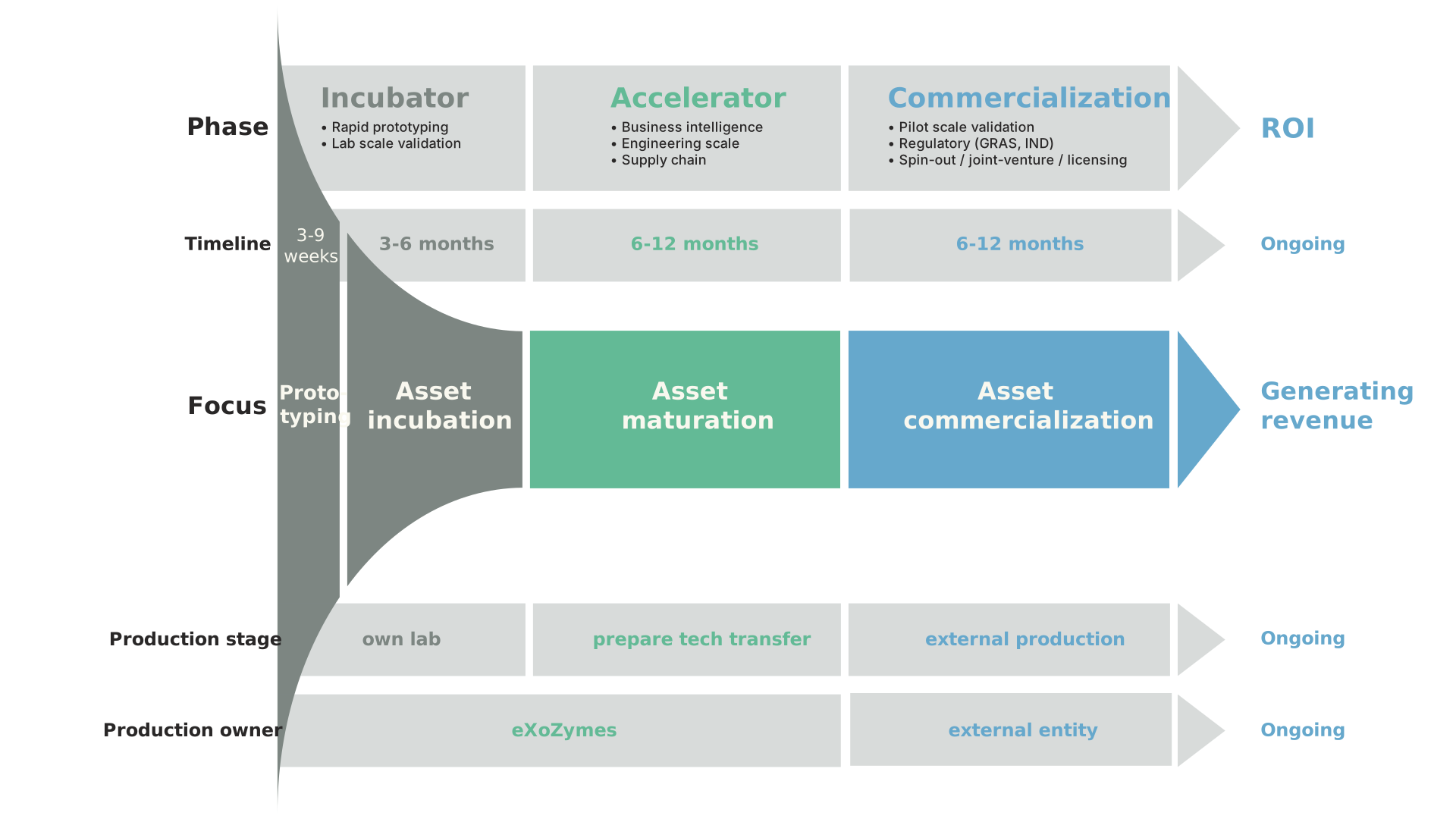
From idea to production

Here's a breakdown of the exozyme process across three overall phases.

Engineering Enhanced Enzymes to Become Exozymes
To create exozymes, enzymes are engineered to function efficiently outside cells. This involves using in-house expertise and artificial intelligence to design modifications that improve their stability, activity, and resistance to industrial conditions like high temperatures or variable pH. AI tools predict beneficial mutations, which are tested iteratively in the lab. The result is a set of highly robust enzymes tailored for cell-free systems.

Lab Preparation: Expressing and Purifying Exozymes
Engineered exozymes are expressed in microbial hosts such as E.coli or yeast and then purified using techniques like chromatography. These steps ensure high purity and stability, while methods such as immobilization or stabilizer additives may be used to enhance performance. The final product is a batch of scalable, ready-to-use exozymes.

Target Production

In the bioreactor, exozymes convert feedstock, such as glucose, into valuable products under carefully controlled conditions. Parameters like temperature and pH are optimized for enzyme efficiency, while integrated systems recycle cofactors to sustain the reactions. The process achieves continuous, high-yield production of bio-based chemicals, bypassing the limitations of cell-based methods.
business-model-4

Inspired by four recent Nobel Prizes

  • 2018 - Directed evolution (Frances H. Arnold) - pioneered strategies. We use this to enhance enzymes to become exozymes. Look at BioClick for more information.

  • 2020 - CRISPR (Emmanuelle Charpentier & Jennifer Doudna) - strains of DNA being designed. We use this to insert the right DNA code in to E.coli in order to express our desired enzymes in the cell.

  • 2022 - Bio-orthogonal click chemistry (Carolyn R. Bertozzi, Morten Meldal, K. Barry Sharpless) - our cell-free approach meets all the definitions of click-chemistry.

  • 2024 - Computation protein design (David Baker, Demis Hassabis, John Jumper). Our founders have co-published with David Baker. We use Rosetta and DeepMind to enhance our exozymes.


Inspired by insights from no less than four recent Nobel Prizes in Chemistry, our technological platform represents the pinnacle of biomanufacturing innovation. A vision so bold as ours can’t be completed without multiple technological advancements, which the founders and our core teams have achieved over the last decade.

This is why we call our platform a paradigm shift: From polluting and toxic petrochemicals to sustainable chemical production using nature’s own processes. Simply a new and sustainable way to make chemicals. Phrased like this, it sounds simple – but it certainly isn’t.

Explaining our technology

Our CEO, Michael Heltzen, explains the difference between enzymes and exozymes, to get an understanding of our technology.

BiochemistryWorkflow(eXoZ)-3
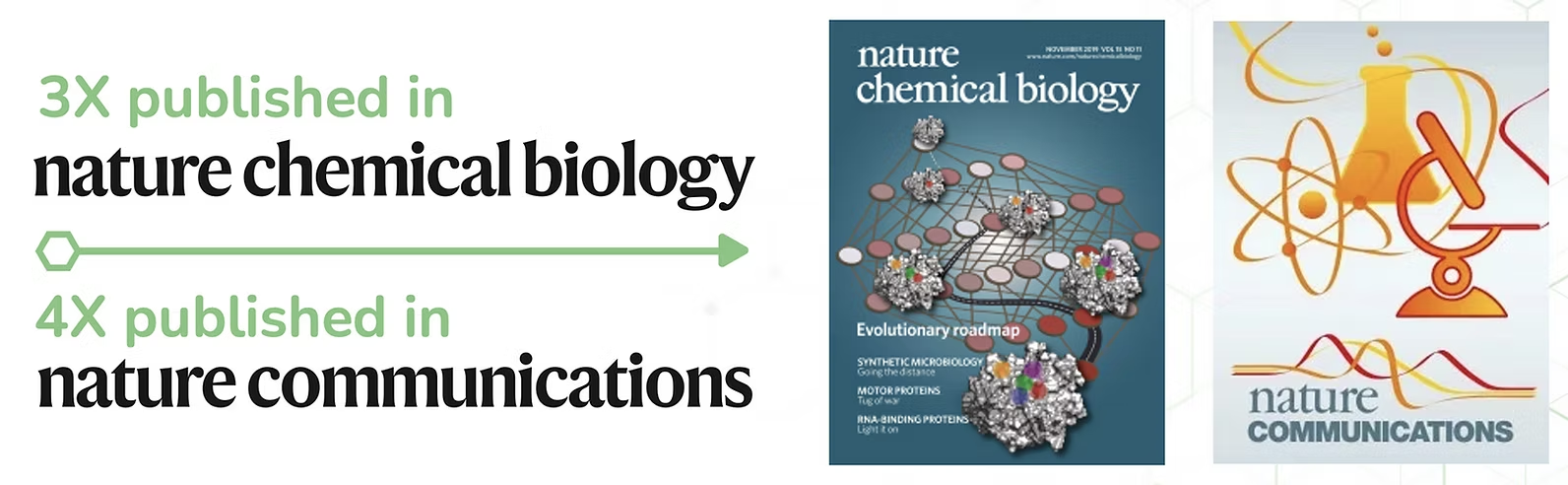
Scientifically validated

Scientifically validated

publications-1-edited

Issued patents

Synthetic biochemistry molecular purge valve module that maintain co-factor balance

Cell-free metabolic pathway for glucose metabolism with a molecular purge valve

Molecular rheostat for cofactor balance

Biosynthetic platform for the production of cannabinoids and other prenylated compounds

Prenyltransferase variants with increased thermostability

Biosynthesis of cyclolavandulyl derivatives of aromatic compounds

Recombinant polypeptides with berberine bridge enzyme activity useful for the biosynthesis of cannabinoids

grow your business with exozymes